
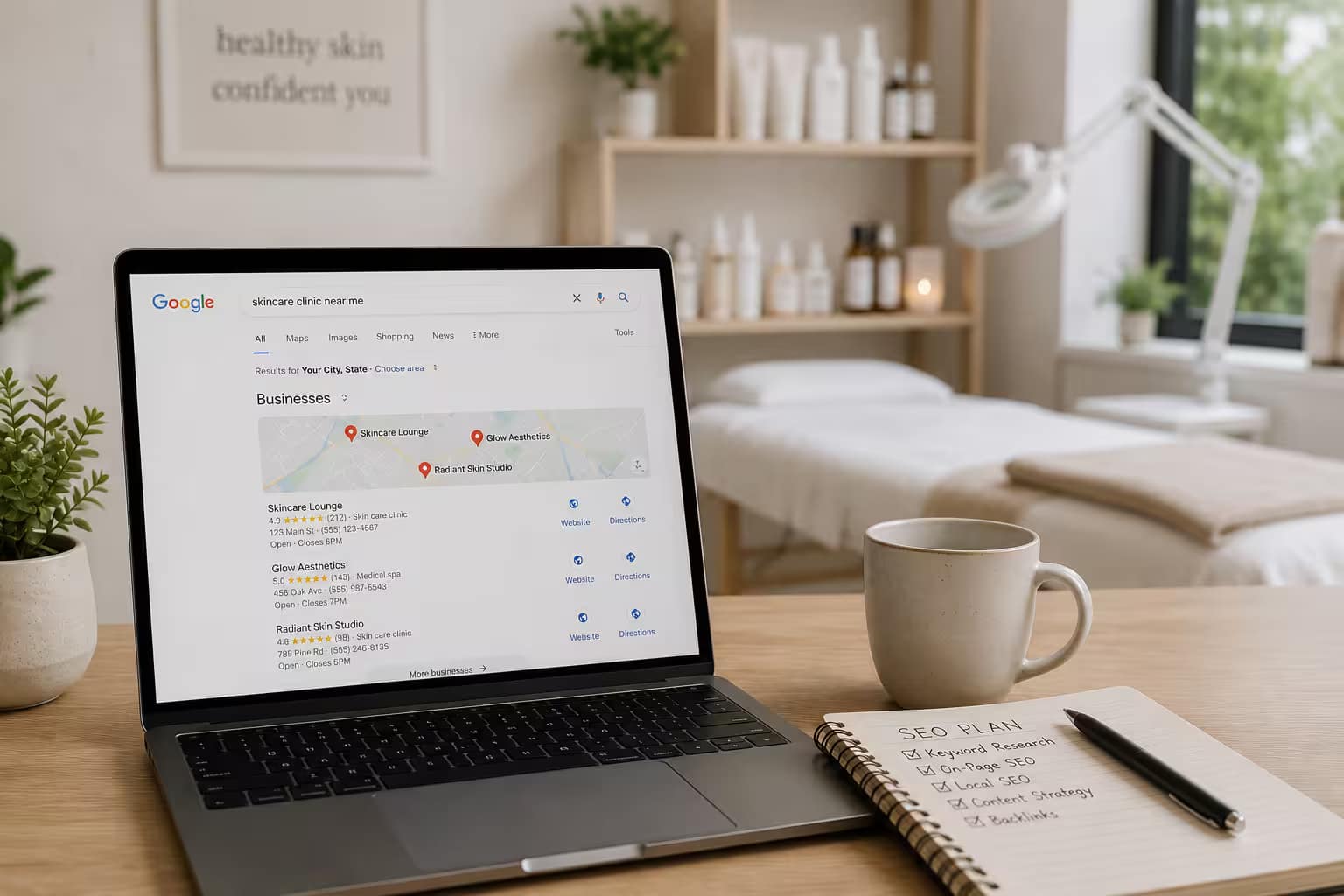

Someone thirty minutes from your clinic just typed “skincare clinic near me” into their phone. They’re not researching. They’re not comparing philosophies. They want an appointment this week, and the vast majority of people who run a search like that visit a business within a day of finding it. The only question is whether your clinic is one of the two or three results they actually see, or whether you’re on page two, invisible to a customer who was ready to book before they even opened Google.
That’s the entire case for SEO in the skincare and aesthetics industry. It’s not a long-term brand play. It’s the difference between capturing demand that already exists in your area and watching a competitor capture it instead. Here’s the playbook, split into what wins locally and what builds authority nationally.
Local SEO: Where Skincare Businesses Actually Win or Lose
Your Google Business Profile is your most important piece of digital real estate, full stop. More than your homepage, more than your Instagram, your Google Business Profile is what shows up in the map pack when someone searches “med spa near me” or “facial [your city].” A profile that’s fully filled out, actively posted to, and stacked with recent, real reviews will consistently outrank a beautiful website that neglects this. Google weighs three things when it decides who shows up in that map pack: how relevant your profile is to the search, how close you are to the searcher, and how prominent your business is, meaning how well-known and well-reviewed you are, both on and off Google. You can’t move your clinic closer to every searcher, but you have full control over the other two.
Photos matter more than most skincare business owners assume. Profiles with a substantial, regularly updated photo library get dramatically more views and more “get directions” or “call” actions than profiles sitting on five photos from three years ago. Treat your Google Business Profile like an active channel, not a one-time setup task: post treatment specials, add new photos monthly, and respond to every review, good or bad.
Reviews are a ranking factor, not just a trust signal. The volume and recency of your reviews directly influences whether you show up in local search results, which means a review-generation habit (asking every satisfied client, right after their appointment, while the experience is fresh) is genuinely an SEO tactic, not just a reputation nice-to-have.
National and Organic SEO: Build Pages Around What People Actually Search
The mistake most skincare businesses make with content is blogging about whatever feels relevant that week. The better approach is building dedicated pages around the specific treatments people search for by name: a real page for Botox, a real page for chemical peels, a real page for microneedling, each one structured to answer the specific questions someone typing that exact treatment name into Google actually has. Generic “our services” pages that cover twelve treatments in three paragraphs rank for almost nothing, because they don’t match the specificity of how people actually search.
Once those treatment pages exist, blog content becomes the layer that supports them: informational posts that answer adjacent questions (“how long does microneedling downtime last,” “chemical peel vs. laser for hyperpigmentation”) and link back to the relevant treatment page. This is how a handful of well-built pages compound into steady organic traffic over months, instead of a blog that publishes constantly but never builds toward anything.
Showing Up in AI Answers, Not Just Search Results
A growing share of people researching a treatment before they book are asking ChatGPT, Perplexity, or Google’s AI Overview directly, rather than clicking through ten blue links. This is a real shift, and it changes how content needs to be written. AI systems tend to pull from pages that answer a question directly and clearly in the first few sentences, use clean headers, and come from a source with visible expertise (a named provider, real credentials, genuine client outcomes) rather than anonymous, generic copy. Practically, this means every treatment page and blog post should open with a direct, plain-language answer to its core question before any narrative lead-in. It’s a small structural change with an outsized effect on whether you get cited by the tools your future clients are increasingly asking instead of Google.
Backlinks Still Matter, Especially in a Trust-Sensitive Industry
Links from other credible websites to yours remain one of the strongest signals of authority, for both traditional rankings and local pack placement. For a skincare business, the realistic path to this isn’t chasing random guest posts. It’s local press mentions, partnerships with complementary local businesses (dermatologists, salons, wellness studios) that link to each other, and being the clinic that gets quoted when a local outlet writes about a skincare trend. Authority accumulates slowly here, but it compounds, and in an industry where trust is the entire sale, a handful of credible mentions can matter more than a hundred low-quality links ever would.
Where to Start This Month
If you do nothing else this month, do these two things: fully complete and start actively posting to your Google Business Profile, and build one properly structured page for your single highest-demand treatment. Everything else in this playbook compounds on top of that foundation. SEO in skincare isn’t about doing everything at once. It’s about doing the highest-leverage things first and building from there.
Not sure where your clinic actually stands in local search right now? MTB Digital runs a free SEO snapshot for skincare and med spa businesses, showing exactly where you rank, where competitors are beating you, and what to fix first. Request your snapshot.